At Therapy Matters, we are passionate about giving every child a voice. For many children with communication delays, augmentative communication systems (AAC) like Key Word Sign can make daily interactions clearer, easier, and more meaningful.
Below, we answer the most commonly asked questions from families and teachers.
What is Key Word Sign?
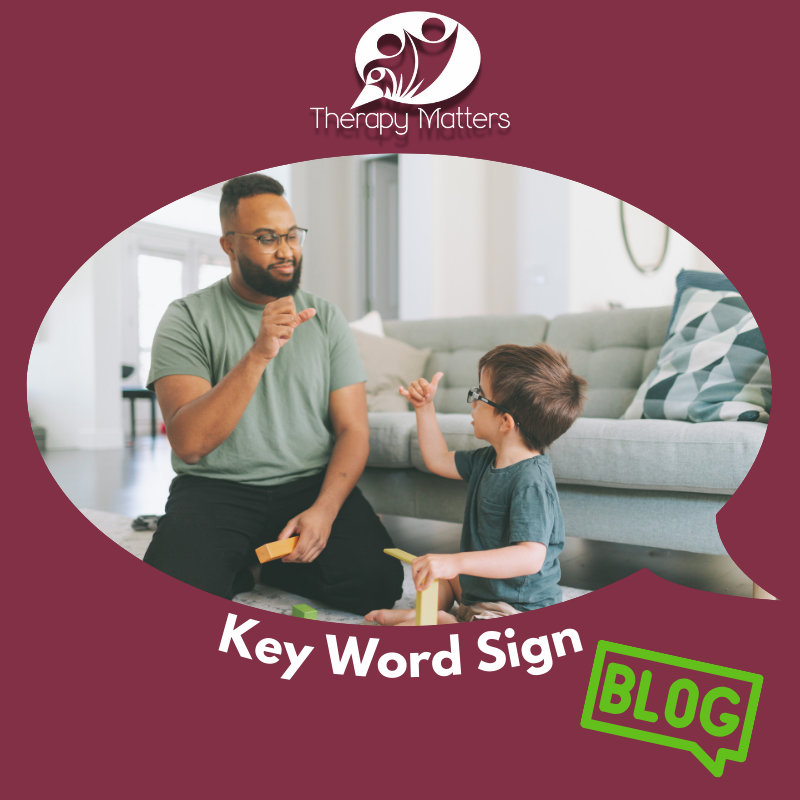
Key Word Sign (KWS) is a communication approach that uses a combination of manual signs and spoken words at the same time. Rather than signing every word in a sentence, you sign only the key words that carry the most meaning. Signs are always paired with natural speech, facial expression, and gesture to communicate as deeply and supportive as possible.
KWS is used the world over using the signs of the Deaf community for each country. In Australia KWS is based on Auslan.
Is Key Word Sign the same as Auslan?
No. While Key Word Sign uses many signs from Auslan, it is not a full language like Auslan. Auslan is a complete, natural language with its own grammar.
Key Word Sign, on the other hand:
- follows English grammar,
- signs only the important words, and
- is used alongside speech.
Who uses Key Word Sign?
Key Word Sign can be used by anyone who wants to support communication, including children, adults, communication partners, and whole communities.
It is frequently used to help:
- people with developmental delays,
- people with disabilities,
- autistic people,
- people with Down syndrome,
- nonspeaking people,
- children with speech sound disorders, and
- children who are developing language while learning to communicate.
It is also widely used by educators, parents, and therapists as a multimodal communication system and as way to deliver inclusive educational settings and communities.
How does Key Word Sign help?
Key Word Sign can support communication in many meaningful ways. Research and clinical experience show it can:
- Reduce frustration: By giving children a functional way to express their needs, choices, and ideas.
- Support understanding (receptive language): Children often understand visual language cues more easily than speech alone, especially in busy environments.
- Build expressive language: Signing can act as a bridge to verbal communication. Many children begin to use more spoken words once they feel confident communicating with signs.
- Slow down adult language: When we sign, we naturally pause, emphasise, and simplify, making language easier for children to process.
- Encourage social interaction: KWS supports turn-taking, shared attention, and successful communication moments between children and adults.
Will Key Word Sign stop my child from talking?
No. Research has consistently shown the opposite. Using Key Word Sign supports the development of spoken language. It reduces pressure, increases successful communication experiences, and builds the foundations for verbal expression. It gives a child a way to understand others, reduce confusion and show what is in their head while speech develops. It builds on a child’s natural ability to use gesture by adding more formal signs with greater meanings.
How do I learn Key Word Sign?
Parents, teachers, and therapists can learn Key Word Sign through:
- Key Word Sign Australia Accredited workshops (in-person and on-line options available),
- In therapy sessions with a speech pathologist, and
- Through modelling and practice in daily routines
If you would like support learning Key Word Sign in your home, school or therapy room, book a full-day, in-person workshop with our team of Key Word Sign Australia Accredited Presenters. We hold full-day Basic and Intermediate workshops once a term on a Saturday and 2 hour Getting Started Workshops in Early Childhood Settings and with Extended Family Groups in their homes or our clinic.
https://therapymatters.com.au/services/workshops/
Can Key Word Sign be used with other communication systems?
Yes, absolutely. In fact, it’s encouraged! Using multiple communication methods together is called Total Communication. No one communication modality is perfect and combining sign, with natural gestures, emerging speech, communication books and high tech AAC communication devices helps people with communication needs express themselves in a way that works best for them.
How do we start using Key Word Sign at home or school?
All it takes is one sign in an everyday routine and you are on your way!
Next steps might involve:
- Adding 5–10 meaningful signs (e.g., more, finished, help, stop, go or play)
- Model them naturally and consistently
- Always speak while signing
- Celebrate all attempts, including signs, gestures, sounds, or words
- Share your knowledge with others as part of an inclusive village that values communicating differently through key word sign
- Ask your speech pathologist which signs align with your child’s goals
Where can I find more information?
Key Word Sign Australia (KWSA) supports, develops and promotes the use of KWS throughout Australia, for the benefit of people with communication difficulties.
Read more at KWSA https://kwsa.org.au/
- Accurate and accessible information about Key Word Sign.
- Resources and products that support the effective use of Key Word Sign.
- Australian-wide in-person and on-line accredited training.
- Accreditation of Key Word Sign Presenters to ensure a consistently high standard.
- Provide robust training pathway to suit all signer needs, from beginner to presenter level.
Supporting communication, connection, and confidence, one sign at a time.
References
Cologon, K., & Mevawalla, Z. (2018). Increasing inclusion in early childhood: Key word sign as a communication partner intervention. International Journal of Inclusive Education, 22(8), 902-920. https://doi.org/10.1080/13603116.2017.1412515
Frizelle, P., Allenby, R., Hassett, E., Holland, O., Ryan, E., Dahly, D., & O’Toole, C. (2022). Embedding key word sign prompts in a shared book reading activity: The impact on communication between children with Down syndrome and their parents. International Journal of Language & Communication Disorders, 58(4), 1029–1045. https://doi.org/10.1111/1460-6984.12842
Key Word Sign Australia. https://kwsa.org.au/what-is-key-word-sign/ [accessed 30th November, 2025]
Millar, D.C., Light, J.C., & Schlosser, R.W. (2006). The Impact of Augmentative and Alternative Communication Intervention on the Speech Production of Individuals With Developmental Disabilities: A Research Review. Journal of Speech, Language and Hearing Research, 49, 248 – 264
Pattison, A.E., & Robertson, R.E. (2016). Simultaneous presentation of speech and sign prompts to increase MLU in children with intellectual disability. Communication Disorders Quarterly, 37(3), 141-147. https://doi.org/10.1177/1525740115583633